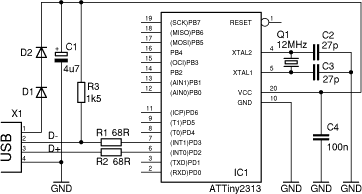
I've been trying to get the HID MOUSE example working from the v-usb package, but it's not working for me.
I have a ATmega162-16PU and I just can't establish an usb connection. My laptop says it's found "a unknown device". I've been working for days now to find the problem, but i just cant find it. it'll be great if someone could help me.(Maybe it's my fuses that are not set right, but i'm not so sure, since i already broken a ATMEGA32-16PU with the wrong fuses...)
Could someone check if my fuses are right and check the code? As I don't have much time left till my deadline...
Anyways Thanks!
This is a picture of my current breadboard, i'm trying to follow this guide(With the HID Bootloader), but no luck(The blue lines are the connectors for ISP programming):

I normally upload the .hex file with "Mysmallusb Light" and with the program: "myAVR_ProgTool"(ISP Programmer), as i don't know how to upload with Avrdude though STK500 with COM1 port(referring to the ISP programmer mentioned earlier).
This is my makefile
Code:
# Name: Makefile
# Project: hid-mouse example
# Author: Christian Starkjohann
# Creation Date: 2008-04-07
# Tabsize: 4
# Copyright: (c) 2008 by OBJECTIVE DEVELOPMENT Software GmbH
# License: GNU GPL v2 (see License.txt), GNU GPL v3 or proprietary (CommercialLicense.txt)
# This Revision: $Id: Makefile 692 2008-11-07 15:07:40Z cs $

DEVICE  = atmega162
F_CPU   = 12000000   # in Hz
FUSE_L  = 0xDF # see below for fuse values for particular devices
FUSE_H  = 0x89
FUSE_E  = 0xFB
AVRDUDE = avrdude -c usbasp -p $(DEVICE) # edit this line for your programmer

CFLAGS  = -Iusbdrv -I. -DDEBUG_LEVEL=0
OBJECTS = usbdrv/usbdrv.o usbdrv/usbdrvasm.o usbdrv/oddebug.o main.o

COMPILE = avr-gcc -Wall -Os -DF_CPU=$(F_CPU) $(CFLAGS) -mmcu=$(DEVICE)

##############################################################################
# Fuse values for particular devices
##############################################################################
# If your device is not listed here, go to
# http://palmavr.sourceforge.net/cgi-bin/fc.cgi
# and choose options for external crystal clock and no clock divider
#
################################## ATMega8 ##################################
# ATMega8 FUSE_L (Fuse low byte):
# 0x9f = 1 0 0 1   1 1 1 1
#        ^ ^ \ /   \--+--/
#        | |  |       +------- CKSEL 3..0 (external >8M crystal)
#        | |  +--------------- SUT 1..0 (crystal osc, BOD enabled)
#        | +------------------ BODEN (BrownOut Detector enabled)
#        +-------------------- BODLEVEL (2.7V)
# ATMega8 FUSE_H (Fuse high byte):
# 0xc9 = 1 1 0 0   1 0 0 1 <-- BOOTRST (boot reset vector at 0x0000)
#        ^ ^ ^ ^   ^ ^ ^------ BOOTSZ0
#        | | | |   | +-------- BOOTSZ1
#        | | | |   + --------- EESAVE (don't preserve EEPROM over chip erase)
#        | | | +-------------- CKOPT (full output swing)
#        | | +---------------- SPIEN (allow serial programming)
#        | +------------------ WDTON (WDT not always on)
#        +-------------------- RSTDISBL (reset pin is enabled)
#
############################## ATMega48/88/168 ##############################
# ATMega*8 FUSE_L (Fuse low byte):
# 0xdf = 1 1 0 1   1 1 1 1
#        ^ ^ \ /   \--+--/
#        | |  |       +------- CKSEL 3..0 (external >8M crystal)
#        | |  +--------------- SUT 1..0 (crystal osc, BOD enabled)
#        | +------------------ CKOUT (if 0: Clock output enabled)
#        +-------------------- CKDIV8 (if 0: divide by 8)
# ATMega*8 FUSE_H (Fuse high byte):
# 0xde = 1 1 0 1   1 1 1 0
#        ^ ^ ^ ^   ^ \-+-/
#        | | | |   |   +------ BODLEVEL 0..2 (110 = 1.8 V)
#        | | | |   + --------- EESAVE (preserve EEPROM over chip erase)
#        | | | +-------------- WDTON (if 0: watchdog always on)
#        | | +---------------- SPIEN (allow serial programming)
#        | +------------------ DWEN (debug wire enable)
#        +-------------------- RSTDISBL (reset pin is enabled)
#
############################## ATTiny25/45/85 ###############################
# ATMega*5 FUSE_L (Fuse low byte):
# 0xef = 1 1 1 0   1 1 1 1
#        ^ ^ \+/   \--+--/
#        | |  |       +------- CKSEL 3..0 (clock selection -> crystal @ 12 MHz)
#        | |  +--------------- SUT 1..0 (BOD enabled, fast rising power)
#        | +------------------ CKOUT (clock output on CKOUT pin -> disabled)
#        +-------------------- CKDIV8 (divide clock by 8 -> don't divide)
# ATMega*5 FUSE_H (Fuse high byte):
# 0xdd = 1 1 0 1   1 1 0 1
#        ^ ^ ^ ^   ^ \-+-/
#        | | | |   |   +------ BODLEVEL 2..0 (brownout trigger level -> 2.7V)
#        | | | |   +---------- EESAVE (preserve EEPROM on Chip Erase -> not preserved)
#        | | | +-------------- WDTON (watchdog timer always on -> disable)
#        | | +---------------- SPIEN (enable serial programming -> enabled)
#        | +------------------ DWEN (debug wire enable)
#        +-------------------- RSTDISBL (disable external reset -> enabled)
#
################################ ATTiny2313 #################################
# ATTiny2313 FUSE_L (Fuse low byte):
# 0xef = 1 1 1 0   1 1 1 1
#        ^ ^ \+/   \--+--/
#        | |  |       +------- CKSEL 3..0 (clock selection -> crystal @ 12 MHz)
#        | |  +--------------- SUT 1..0 (BOD enabled, fast rising power)
#        | +------------------ CKOUT (clock output on CKOUT pin -> disabled)
#        +-------------------- CKDIV8 (divide clock by 8 -> don't divide)
# ATTiny2313 FUSE_H (Fuse high byte):
# 0xdb = 1 1 0 1   1 0 1 1
#        ^ ^ ^ ^   \-+-/ ^
#        | | | |     |   +---- RSTDISBL (disable external reset -> enabled)
#        | | | |     +-------- BODLEVEL 2..0 (brownout trigger level -> 2.7V)
#        | | | +-------------- WDTON (watchdog timer always on -> disable)
#        | | +---------------- SPIEN (enable serial programming -> enabled)
#        | +------------------ EESAVE (preserve EEPROM on Chip Erase -> not preserved)
#        +-------------------- DWEN (debug wire enable)


# symbolic targets:
help:
   @echo "This Makefile has no default rule. Use one of the following:"
   @echo "make hex ....... to build main.hex"
   @echo "make program ... to flash fuses and firmware"
   @echo "make fuse ...... to flash the fuses"
   @echo "make flash ..... to flash the firmware (use this on metaboard)"
   @echo "make clean ..... to delete objects and hex file"

all: hex

hex: main.hex

program: flash fuse

# rule for programming fuse bits:
fuse:
   @[ "$(FUSE_H)" != "" -a "$(FUSE_L)" != "" ] || \
      { echo "*** Edit Makefile and choose values for FUSE_L and FUSE_H!"; exit 1; }
   $(AVRDUDE) -U hfuse:w:$(FUSE_H):m -U lfuse:w:$(FUSE_L):m

# rule for uploading firmware:
flash: main.hex
   $(AVRDUDE) -U flash:w:main.hex:i

# rule for deleting dependent files (those which can be built by Make):
clean:
   rm -f main.hex main.lst main.obj main.cof main.list main.map main.eep.hex main.elf *.o usbdrv/*.o main.s usbdrv/oddebug.s usbdrv/usbdrv.s

# Generic rule for compiling C files:
.c.o:
   $(COMPILE) -c $< -o $@

# Generic rule for assembling Assembler source files:
.S.o:
   $(COMPILE) -x assembler-with-cpp -c $< -o $@
# "-x assembler-with-cpp" should not be necessary since this is the default
# file type for the .S (with capital S) extension. However, upper case
# characters are not always preserved on Windows. To ensure WinAVR
# compatibility define the file type manually.

# Generic rule for compiling C to assembler, used for debugging only.
.c.s:
   $(COMPILE) -S $< -o $@

# file targets:

# Since we don't want to ship the driver multipe times, we copy it into this project:
usbdrv:
   cp -r ../../../usbdrv .

main.elf: usbdrv $(OBJECTS)   # usbdrv dependency only needed because we copy it
   $(COMPILE) -o main.elf $(OBJECTS)

main.hex: main.elf
   rm -f main.hex main.eep.hex
   avr-objcopy -j .text -j .data -O ihex main.elf main.hex
   avr-size main.hex

# debugging targets:

disasm:   main.elf
   avr-objdump -d main.elf

cpp:
   $(COMPILE) -E main.c
This is my usbconfig.h
Code:
/* Name: usbconfig.h
 * Project: V-USB, virtual USB port for Atmel's(r) AVR(r) microcontrollers
 * Author: Christian Starkjohann
 * Creation Date: 2005-04-01
 * Tabsize: 4
 * Copyright: (c) 2005 by OBJECTIVE DEVELOPMENT Software GmbH
 * License: GNU GPL v2 (see License.txt), GNU GPL v3 or proprietary (CommercialLicense.txt)
 * This Revision: $Id: usbconfig-prototype.h 785 2010-05-30 17:57:07Z cs $
 */

#ifndef __usbconfig_h_included__
#define __usbconfig_h_included__

/*
General Description:
This file is an example configuration (with inline documentation) for the USB
driver. It configures V-USB for USB D+ connected to Port D bit 2 (which is
also hardware interrupt 0 on many devices) and USB D- to Port D bit 4. You may
wire the lines to any other port, as long as D+ is also wired to INT0 (or any
other hardware interrupt, as long as it is the highest level interrupt, see
section at the end of this file).
*/

/* ---------------------------- Hardware Config ---------------------------- */

#define USB_CFG_IOPORTNAME      D
/* This is the port where the USB bus is connected. When you configure it to
 * "B", the registers PORTB, PINB and DDRB will be used.
 */
#define USB_CFG_DMINUS_BIT      3
/* This is the bit number in USB_CFG_IOPORT where the USB D- line is connected.
 * This may be any bit in the port.
 */
#define USB_CFG_DPLUS_BIT       2
/* This is the bit number in USB_CFG_IOPORT where the USB D+ line is connected.
 * This may be any bit in the port. Please note that D+ must also be connected
 * to interrupt pin INT0! [You can also use other interrupts, see section
 * "Optional MCU Description" below, or you can connect D- to the interrupt, as
 * it is required if you use the USB_COUNT_SOF feature. If you use D- for the
 * interrupt, the USB interrupt will also be triggered at Start-Of-Frame
 * markers every millisecond.]
 */
#define USB_CFG_CLOCK_KHZ       (F_CPU/1000)
/* Clock rate of the AVR in kHz. Legal values are 12000, 12800, 15000, 16000,
 * 16500, 18000 and 20000. The 12.8 MHz and 16.5 MHz versions of the code
 * require no crystal, they tolerate +/- 1% deviation from the nominal
 * frequency. All other rates require a precision of 2000 ppm and thus a
 * crystal!
 * Since F_CPU should be defined to your actual clock rate anyway, you should
 * not need to modify this setting.
 */
#define USB_CFG_CHECK_CRC       0
/* Define this to 1 if you want that the driver checks integrity of incoming
 * data packets (CRC checks). CRC checks cost quite a bit of code size and are
 * currently only available for 18 MHz crystal clock. You must choose
 * USB_CFG_CLOCK_KHZ = 18000 if you enable this option.
 */

/* ----------------------- Optional Hardware Config ------------------------ */

#define USB_CFG_PULLUP_IOPORTNAME   D
/* If you connect the 1.5k pullup resistor from D- to a port pin instead of
 * V+, you can connect and disconnect the device from firmware by calling
 * the macros usbDeviceConnect() and usbDeviceDisconnect() (see usbdrv.h).
 * This constant defines the port on which the pullup resistor is connected.
 */
#define USB_CFG_PULLUP_BIT          4
/* This constant defines the bit number in USB_CFG_PULLUP_IOPORT (defined
 * above) where the 1.5k pullup resistor is connected. See description
 * above for details.
 */

/* --------------------------- Functional Range ---------------------------- */

#define USB_CFG_HAVE_INTRIN_ENDPOINT    1
/* Define this to 1 if you want to compile a version with two endpoints: The
 * default control endpoint 0 and an interrupt-in endpoint (any other endpoint
 * number).
 */
#define USB_CFG_HAVE_INTRIN_ENDPOINT3   0
/* Define this to 1 if you want to compile a version with three endpoints: The
 * default control endpoint 0, an interrupt-in endpoint 3 (or the number
 * configured below) and a catch-all default interrupt-in endpoint as above.
 * You must also define USB_CFG_HAVE_INTRIN_ENDPOINT to 1 for this feature.
 */
#define USB_CFG_EP3_NUMBER              3
/* If the so-called endpoint 3 is used, it can now be configured to any other
 * endpoint number (except 0) with this macro. Default if undefined is 3.
 */
/* #define USB_INITIAL_DATATOKEN           USBPID_DATA1 */
/* The above macro defines the startup condition for data toggling on the
 * interrupt/bulk endpoints 1 and 3. Defaults to USBPID_DATA1.
 * Since the token is toggled BEFORE sending any data, the first packet is
 * sent with the oposite value of this configuration!
 */
#define USB_CFG_IMPLEMENT_HALT          0
/* Define this to 1 if you also want to implement the ENDPOINT_HALT feature
 * for endpoint 1 (interrupt endpoint). Although you may not need this feature,
 * it is required by the standard. We have made it a config option because it
 * bloats the code considerably.
 */
#define USB_CFG_SUPPRESS_INTR_CODE      0
/* Define this to 1 if you want to declare interrupt-in endpoints, but don't
 * want to send any data over them. If this macro is defined to 1, functions
 * usbSetInterrupt() and usbSetInterrupt3() are omitted. This is useful if
 * you need the interrupt-in endpoints in order to comply to an interface
 * (e.g. HID), but never want to send any data. This option saves a couple
 * of bytes in flash memory and the transmit buffers in RAM.
 */
#define USB_CFG_INTR_POLL_INTERVAL      100
/* If you compile a version with endpoint 1 (interrupt-in), this is the poll
 * interval. The value is in milliseconds and must not be less than 10 ms for
 * low speed devices.
 */
#define USB_CFG_IS_SELF_POWERED         0
/* Define this to 1 if the device has its own power supply. Set it to 0 if the
 * device is powered from the USB bus.
 */
#define USB_CFG_MAX_BUS_POWER           20
/* Set this variable to the maximum USB bus power consumption of your device.
 * The value is in milliamperes. [It will be divided by two since USB
 * communicates power requirements in units of 2 mA.]
 */
#define USB_CFG_IMPLEMENT_FN_WRITE      0
/* Set this to 1 if you want usbFunctionWrite() to be called for control-out
 * transfers. Set it to 0 if you don't need it and want to save a couple of
 * bytes.
 */
#define USB_CFG_IMPLEMENT_FN_READ       0
/* Set this to 1 if you need to send control replies which are generated
 * "on the fly" when usbFunctionRead() is called. If you only want to send
 * data from a static buffer, set it to 0 and return the data from
 * usbFunctionSetup(). This saves a couple of bytes.
 */
#define USB_CFG_IMPLEMENT_FN_WRITEOUT   0
/* Define this to 1 if you want to use interrupt-out (or bulk out) endpoints.
 * You must implement the function usbFunctionWriteOut() which receives all
 * interrupt/bulk data sent to any endpoint other than 0. The endpoint number
 * can be found in 'usbRxToken'.
 */
#define USB_CFG_HAVE_FLOWCONTROL        0
/* Define this to 1 if you want flowcontrol over USB data. See the definition
 * of the macros usbDisableAllRequests() and usbEnableAllRequests() in
 * usbdrv.h.
 */
#define USB_CFG_DRIVER_FLASH_PAGE       0
/* If the device has more than 64 kBytes of flash, define this to the 64 k page
 * where the driver's constants (descriptors) are located. Or in other words:
 * Define this to 1 for boot loaders on the ATMega128.
 */
#define USB_CFG_LONG_TRANSFERS          0
/* Define this to 1 if you want to send/receive blocks of more than 254 bytes
 * in a single control-in or control-out transfer. Note that the capability
 * for long transfers increases the driver size.
 */
/* #define USB_RX_USER_HOOK(data, len)     if(usbRxToken == (uchar)USBPID_SETUP) blinkLED(); */
/* This macro is a hook if you want to do unconventional things. If it is
 * defined, it's inserted at the beginning of received message processing.
 * If you eat the received message and don't want default processing to
 * proceed, do a return after doing your things. One possible application
 * (besides debugging) is to flash a status LED on each packet.
 */
/* #define USB_RESET_HOOK(resetStarts)     if(!resetStarts){hadUsbReset();} */
/* This macro is a hook if you need to know when an USB RESET occurs. It has
 * one parameter which distinguishes between the start of RESET state and its
 * end.
 */
/* #define USB_SET_ADDRESS_HOOK()              hadAddressAssigned(); */
/* This macro (if defined) is executed when a USB SET_ADDRESS request was
 * received.
 */
#define USB_COUNT_SOF                   0
/* define this macro to 1 if you need the global variable "usbSofCount" which
 * counts SOF packets. This feature requires that the hardware interrupt is
 * connected to D- instead of D+.
 */
/* #ifdef __ASSEMBLER__
 * macro myAssemblerMacro
 *     in      YL, TCNT0
 *     sts     timer0Snapshot, YL
 *     endm
 * #endif
 * #define USB_SOF_HOOK                    myAssemblerMacro
 * This macro (if defined) is executed in the assembler module when a
 * Start Of Frame condition is detected. It is recommended to define it to
 * the name of an assembler macro which is defined here as well so that more
 * than one assembler instruction can be used. The macro may use the register
 * YL and modify SREG. If it lasts longer than a couple of cycles, USB messages
 * immediately after an SOF pulse may be lost and must be retried by the host.
 * What can you do with this hook? Since the SOF signal occurs exactly every
 * 1 ms (unless the host is in sleep mode), you can use it to tune OSCCAL in
 * designs running on the internal RC oscillator.
 * Please note that Start Of Frame detection works only if D- is wired to the
 * interrupt, not D+. THIS IS DIFFERENT THAN MOST EXAMPLES!
 */
#define USB_CFG_CHECK_DATA_TOGGLING     0
/* define this macro to 1 if you want to filter out duplicate data packets
 * sent by the host. Duplicates occur only as a consequence of communication
 * errors, when the host does not receive an ACK. Please note that you need to
 * implement the filtering yourself in usbFunctionWriteOut() and
 * usbFunctionWrite(). Use the global usbCurrentDataToken and a static variable
 * for each control- and out-endpoint to check for duplicate packets.
 */
#define USB_CFG_HAVE_MEASURE_FRAME_LENGTH   0
/* define this macro to 1 if you want the function usbMeasureFrameLength()
 * compiled in. This function can be used to calibrate the AVR's RC oscillator.
 */
#define USB_USE_FAST_CRC                0
/* The assembler module has two implementations for the CRC algorithm. One is
 * faster, the other is smaller. This CRC routine is only used for transmitted
 * messages where timing is not critical. The faster routine needs 31 cycles
 * per byte while the smaller one needs 61 to 69 cycles. The faster routine
 * may be worth the 32 bytes bigger code size if you transmit lots of data and
 * run the AVR close to its limit.
 */

/* -------------------------- Device Description --------------------------- */

#define  USB_CFG_VENDOR_ID       0xc0, 0x16 /* = 0x16c0 = 5824 = voti.nl */
/* USB vendor ID for the device, low byte first. If you have registered your
 * own Vendor ID, define it here. Otherwise you may use one of obdev's free
 * shared VID/PID pairs. Be sure to read USB-IDs-for-free.txt for rules!
 * *** IMPORTANT NOTE ***
 * This template uses obdev's shared VID/PID pair for Vendor Class devices
 * with libusb: 0x16c0/0x5dc.  Use this VID/PID pair ONLY if you understand
 * the implications!
 */
#define  USB_CFG_DEVICE_ID       0xe8, 0x03 /* VOTI's lab use PID */
/* This is the ID of the product, low byte first. It is interpreted in the
 * scope of the vendor ID. If you have registered your own VID with usb.org
 * or if you have licensed a PID from somebody else, define it here. Otherwise
 * you may use one of obdev's free shared VID/PID pairs. See the file
 * USB-IDs-for-free.txt for details!
 * *** IMPORTANT NOTE ***
 * This template uses obdev's shared VID/PID pair for Vendor Class devices
 * with libusb: 0x16c0/0x5dc.  Use this VID/PID pair ONLY if you understand
 * the implications!
 */
#define USB_CFG_DEVICE_VERSION  0x00, 0x01
/* Version number of the device: Minor number first, then major number.
 */
#define USB_CFG_VENDOR_NAME     'o', 'b', 'd', 'e', 'v', '.', 'a', 't'
#define USB_CFG_VENDOR_NAME_LEN 8
/* These two values define the vendor name returned by the USB device. The name
 * must be given as a list of characters under single quotes. The characters
 * are interpreted as Unicode (UTF-16) entities.
 * If you don't want a vendor name string, undefine these macros.
 * ALWAYS define a vendor name containing your Internet domain name if you use
 * obdev's free shared VID/PID pair. See the file USB-IDs-for-free.txt for
 * details.
 */
#define USB_CFG_DEVICE_NAME     'M', 'o', 'u', 's', 'e'
#define USB_CFG_DEVICE_NAME_LEN 5
/* Same as above for the device name. If you don't want a device name, undefine
 * the macros. See the file USB-IDs-for-free.txt before you assign a name if
 * you use a shared VID/PID.
 */
/*#define USB_CFG_SERIAL_NUMBER   'N', 'o', 'n', 'e' */
/*#define USB_CFG_SERIAL_NUMBER_LEN   0 */
/* Same as above for the serial number. If you don't want a serial number,
 * undefine the macros.
 * It may be useful to provide the serial number through other means than at
 * compile time. See the section about descriptor properties below for how
 * to fine tune control over USB descriptors such as the string descriptor
 * for the serial number.
 */
#define USB_CFG_DEVICE_CLASS        0
#define USB_CFG_DEVICE_SUBCLASS     0
/* See USB specification if you want to conform to an existing device class.
 * Class 0xff is "vendor specific".
 */
#define USB_CFG_INTERFACE_CLASS     3
#define USB_CFG_INTERFACE_SUBCLASS  0
#define USB_CFG_INTERFACE_PROTOCOL  0
/* See USB specification if you want to conform to an existing device class or
 * protocol. The following classes must be set at interface level:
 * HID class is 3, no subclass and protocol required (but may be useful!)
 * CDC class is 2, use subclass 2 and protocol 1 for ACM
 */
#define USB_CFG_HID_REPORT_DESCRIPTOR_LENGTH    52
/* Define this to the length of the HID report descriptor, if you implement
 * an HID device. Otherwise don't define it or define it to 0.
 * If you use this define, you must add a PROGMEM character array named
 * "usbHidReportDescriptor" to your code which contains the report descriptor.
 * Don't forget to keep the array and this define in sync!
 */

/* #define USB_PUBLIC static */
/* Use the define above if you #include usbdrv.c instead of linking against it.
 * This technique saves a couple of bytes in flash memory.
 */

/* ------------------- Fine Control over USB Descriptors ------------------- */
/* If you don't want to use the driver's default USB descriptors, you can
 * provide our own. These can be provided as (1) fixed length static data in
 * flash memory, (2) fixed length static data in RAM or (3) dynamically at
 * runtime in the function usbFunctionDescriptor(). See usbdrv.h for more
 * information about this function.
 * Descriptor handling is configured through the descriptor's properties. If
 * no properties are defined or if they are 0, the default descriptor is used.
 * Possible properties are:
 *   + USB_PROP_IS_DYNAMIC: The data for the descriptor should be fetched
 *     at runtime via usbFunctionDescriptor(). If the usbMsgPtr mechanism is
 *     used, the data is in FLASH by default. Add property USB_PROP_IS_RAM if
 *     you want RAM pointers.
 *   + USB_PROP_IS_RAM: The data returned by usbFunctionDescriptor() or found
 *     in static memory is in RAM, not in flash memory.
 *   + USB_PROP_LENGTH(len): If the data is in static memory (RAM or flash),
 *     the driver must know the descriptor's length. The descriptor itself is
 *     found at the address of a well known identifier (see below).
 * List of static descriptor names (must be declared PROGMEM if in flash):
 *   char usbDescriptorDevice[];
 *   char usbDescriptorConfiguration[];
 *   char usbDescriptorHidReport[];
 *   char usbDescriptorString0[];
 *   int usbDescriptorStringVendor[];
 *   int usbDescriptorStringDevice[];
 *   int usbDescriptorStringSerialNumber[];
 * Other descriptors can't be provided statically, they must be provided
 * dynamically at runtime.
 *
 * Descriptor properties are or-ed or added together, e.g.:
 * #define USB_CFG_DESCR_PROPS_DEVICE   (USB_PROP_IS_RAM | USB_PROP_LENGTH(18))
 *
 * The following descriptors are defined:
 *   USB_CFG_DESCR_PROPS_DEVICE
 *   USB_CFG_DESCR_PROPS_CONFIGURATION
 *   USB_CFG_DESCR_PROPS_STRINGS
 *   USB_CFG_DESCR_PROPS_STRING_0
 *   USB_CFG_DESCR_PROPS_STRING_VENDOR
 *   USB_CFG_DESCR_PROPS_STRING_PRODUCT
 *   USB_CFG_DESCR_PROPS_STRING_SERIAL_NUMBER
 *   USB_CFG_DESCR_PROPS_HID
 *   USB_CFG_DESCR_PROPS_HID_REPORT
 *   USB_CFG_DESCR_PROPS_UNKNOWN (for all descriptors not handled by the driver)
 *
 * Note about string descriptors: String descriptors are not just strings, they
 * are Unicode strings prefixed with a 2 byte header. Example:
 * int  serialNumberDescriptor[] = {
 *     USB_STRING_DESCRIPTOR_HEADER(6),
 *     'S', 'e', 'r', 'i', 'a', 'l'
 * };
 */

#define USB_CFG_DESCR_PROPS_DEVICE                  0
#define USB_CFG_DESCR_PROPS_CONFIGURATION           0
#define USB_CFG_DESCR_PROPS_STRINGS                 0
#define USB_CFG_DESCR_PROPS_STRING_0                0
#define USB_CFG_DESCR_PROPS_STRING_VENDOR           0
#define USB_CFG_DESCR_PROPS_STRING_PRODUCT          0
#define USB_CFG_DESCR_PROPS_STRING_SERIAL_NUMBER    0
#define USB_CFG_DESCR_PROPS_HID                     0
#define USB_CFG_DESCR_PROPS_HID_REPORT              0
#define USB_CFG_DESCR_PROPS_UNKNOWN                 0

/* ----------------------- Optional MCU Description ------------------------ */

/* The following configurations have working defaults in usbdrv.h. You
 * usually don't need to set them explicitly. Only if you want to run
 * the driver on a device which is not yet supported or with a compiler
 * which is not fully supported (such as IAR C) or if you use a differnt
 * interrupt than INT0, you may have to define some of these.
 */
/* #define USB_INTR_CFG            MCUCR */
/* #define USB_INTR_CFG_SET        ((1 << ISC00) | (1 << ISC01)) */
/* #define USB_INTR_CFG_CLR        0 */
/* #define USB_INTR_ENABLE         GIMSK */
/* #define USB_INTR_ENABLE_BIT     INT0 */
/* #define USB_INTR_PENDING        GIFR */
/* #define USB_INTR_PENDING_BIT    INTF0 */
/* #define USB_INTR_VECTOR         INT0_vect */

#endif /* __usbconfig_h_included__ */
Statistics: Posted by IloveIphonyWikyBolex — Sun Jan 08, 2012 12:11 am
]]>